All
Rights Reserved
Performance Rights - SOCAN
LCAMS - Fellow - USMA
Writer "SI" Documents - ANMC
No unauthorized reproduction or
download or upload of
content permitted.
Terms for Use and Privacy*
The INTERNATIONAL
SYSTEM of UNITS (SI)
is a modernized version of the metric system established by
international agreement that provides a logical and interconnected
framework for all measurements in science, industry and commerce.
This system is built on a foundation of seven base units and all other
units are derived from them.
According to the US Department of Commerce
National Bureau of Standards use of metric measurement was legalized
in the United States
in 1856 and our everyday customary
BASE UNITS of measurement are
defined in terms of the
meter for length and
kilogram for mass.
All
other units are derived from the base unit meter. For Essentials of SI: Base and Derived Units visit http://physics.nist.gov/cuu/Units.html meter
•
second
•
kilogram
• Kelvin
• ampere
•
candela
•
mole
BASE
UNIT - meter (m) - LENGTH.
Up until 1983 the meter was defined as 1,650,763.73
wavelengths in a vacuum of the orange-red line of the spectrum of
krypton-86. And since then it is determined to be the distance traveled
by light in a vacuum in 1/299,792,45 of a second.
BASE
UNIT - second (s) - TIME
The second is defined as the duration of 9,192,631,770
cycles of the radiation associated with a specified transition of the
cesium-133 atom.
BASE
UNIT - kilogram (kg) - MASS
The standard for the kilogram is a cylinder of
platinum-iridium alloy kept by the International Bureau of Weights and
Measures in Paris.
A duplicate at the National Bureau of Standards
serves as the mass standard for the United States. The kilogram is the
only base unit defined by a physical object.
BASE
UNIT - Kelvin (K) and degree Celsius (ฐC)
- TEMPERATURE
The Kelvin is defined as the fraction 1/273.16 of the
thermodynamic temperature of the triple point of water; that is, the
point at which water forms an interface of solid, liquid and vapor. This
is defined as 0.01 ฐC on the Celsius scale and 32.02 ฐF on the
Fahrenheit scale. The temperature zero K (Kelvin) is called
"absolute zero".
BASE
UNIT - ampere (A) - ELECTRIC
CURRENT
The ampere is defined as that current that, if maintained
in each of two long parallel wires separated by one meter in free space,
would produce a force between the two wires (due to their magnetic
fields) of 2 x 10⁻⁷ N (newton) for each meter of length. (a
newton is the unit of force that, when applied to one kilogram mass would
experience an acceleration of one meter per second, per second).
BASE
UNIT - candela (cd) - LUMINOUS
INTENSITY
The candela is defined as the luminous intensity of
1/600,000 of a
square meter of a cavity at the temperature of freezing
platinum (2,042 K). COMPLETE TEMPERATURE DETAILS VISIT http://lamar.colostate.edu/~hillger/temps.htm
BASE
UNIT - mole - (mol) AMOUNT OF
SUBSTANCE
The mole is the amount of substance of a system that
contains as many elementary entities as there are atoms in 0.012
kilogram of carbon-12.
For Classroom Learning Only.
Must Be Certified Public Education Facility.
One printing per session.
Duplication is Prohibited.
AUTHORIZATION NUMBER
Share This
with Others!
•
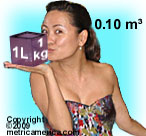
DID
YOU KNOW
you can divide
1 meter
by exactly
10 equal parts
(10 cm each side)
then make
a cube (1000 cmณ) of it to fill
with
water
and you will find that it contains
exactly
1 L (1 litre)
(1000 mL)
of water
and
is the mass
of exactly
1
kg (1 kilogram) (1000 g).
ALL SIMPLY RELATED
IN 10!